

At least 1,13,925 teaching posts remain vacant at government primary, secondary and higher secondary levels, disrupting academic activities across the country.
Of the vacant posts, around 43,000 are in government primary schools, 55,374 in MPO-listed educational institutions, 3,409 in government secondary schools, 8,486 in technical educational institutions, and 3,656 at the government higher secondary level, according to ministries and relevant directorates.
–
- Teacher shortage disrupts classes
- Edn’s role in socio-cultural dev undermined
- Country’s economic productivity weakens
The shortage is making it difficult for educational institutions to ensure regular classes and thus maintain the quality of education.
The crisis is particularly acute in rural, remote, and char areas, where students often have to attend classes taught by teachers from unrelated disciplines.
Boalmari Government Girls’ High School in Faridpur illustrates the situation.
The school has more than 500 students but only three regular teachers against 12 sanctioned posts, leaving nine positions vacant for a long period.
The situation has worsened as one of the three teachers, who teaches English, is undergoing Bachelor of Education training, further cutting the number of teachers available for regular classes.
The school authorities have hired four part-time guest teachers to keep classes running. Students, however, say the temporary arrangement has failed to compensate for the shortage of regular and subject-specific teachers.
Anika Sarkar, a ninth-grade science student, says higher mathematics classes are not held regularly because the school has no teacher for the subject.
‘Even though our school has a dedicated science laboratory, practical classes have been completely suspended for a long time due to the lack of instructors,’ she said.
Headteacher Sukanta Chandra Mondal says he has informed the higher authorities about the shortage soon after taking charge in February this year.
Professor Mohammad Mojibur Rahman of Dhaka University’s Institute of Education and Research tells New Age that the teacher shortage is undermining students’ learning outcomes and widening learning gaps.
‘When students fail to acquire the knowledge and skills expected at each grade, the learning gaps accumulate as they progress in the education system. Eventually, they enter higher education levels and the job market without the competencies required of them,’ he says.
He says the shortage also undermines education’s role in socio-cultural development and weakens the country’s economic productivity, and competitiveness at the global level.
According to Professor Mojibur, the government should urgently recruit qualified and competent teachers, stressing that recruitment must ensure both quality and quantity.
He calls for the establishment of a powerful and independent commission to recruit primary and secondary school teachers, arguing that the existing recruitment system is fragmented and lacks sufficient systemic rigor.
Bangladesh has 65,569 government primary schools with 4,29,531 sanctioned teaching posts. Around 43,000 posts, including 36,235 headteacher posts, remain vacant despite the recruitment and joining of approximately 14,000 assistant teachers this month.
The shortage is particularly severe in remote and char areas, with teacher distribution remaining uneven, because many assistant teachers are posted in district towns, metropolitan areas, and capital Dhaka.
The situation is also serious in government secondary schools.
According to the Directorate of Secondary and Higher Education, 383 of the country’s 693 government secondary schools, or around 55 per cent, do not have headteachers.
As of September, 13,192 teachers were working against 16,601 sanctioned posts in government secondary schools, leaving 3,409 positions vacant.
The shortage is particularly acute in science, mathematics, and information and communication technology. Teachers from other disciplines are often required to teach these subjects, widening learning gaps among students.
Professor Khan Moinuddin Al Mahmud Sohel, DSHE director general, tells New Age that requisitions are regularly sent to the Public Service Commission through the education ministry to fill vacant posts in the BCS general education cadre and government secondary schools.
He adds that steps will be taken soon in line with instructions from the education ministry to address the crisis.
MPO-listed private educational institutions are also facing a major shortage of teachers. At present, 5,98,994 teachers are working in these institutions across the country.
The results of the seventh special recruitment circular of the Non-Government Teachers’ Registration and Certification Authority were published on January 28 this year.
Against the 67,087 advertised vacancies, only 18,399 applications were submitted. Following scrutiny, NTRCA recommended 11,713 candidates for recruitment, leaving 55,374 posts vacant.
According to the education ministry, around 28,000 teachers – 15,500 in old government colleges and 12500 in nationalised government colleges – are working at 653 government colleges, where 3,656 teaching posts remain vacant.
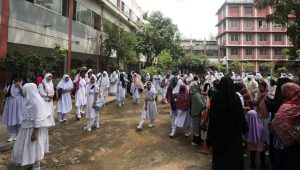
The number of vacant posts for BCS cadre lecturers at older government colleges stands at 656, while some 3,000 lecturer posts remain vacant at nationalised government colleges.
The teacher shortage is also affecting technical education, despite the government’s emphasis on expanding the sector.
On June 28, education minister ANM Ehsanul Haque Milon told the Jatiya Sangsad that 8,486 of the 15,844 sanctioned teaching posts in technical educational institutions were vacant, leaving more than half of the positions vacant.
Ministry officials say a requisition has been sent to the Public Service Commission seeking recruitment recommendations for 2,204 vacant posts.
The shortage has serious implications also for technical education, where practical training is as important as classroom instruction.